When I started this blog I was convinced that cellidor could only be polished by hand. I was afraid that a machine would damage the rather delicate material, but after some trial and error with a small polishing wheel on my Dremel I noticed that the high speed didn't damage the Cellidor scales. I bought an adjustable drill-clamp, a cheap power drill and a polishing cloth with paste. I use this setup almost for a year now and must say that every knife I repaired looks like new! The manual method works too, but this is so much easier and faster! Please keep in mind that the slow-motion I inserted in the movie is for warning purposes! This can and will happen to you too, so be careful!!! I've had tools flying around when I tried to re-polish separate blades and reamers (when I polish smaller objects, I always use safety goggles) !

Saturday, January 18, 2014

Tuesday, January 14, 2014
Collection overview (VIDEO)
As a proud owner of a GoPro Hero3 I had the opportunity to film my collection... I hope you enjoy it!
Thursday, January 9, 2014
Victorinox kitchen knives

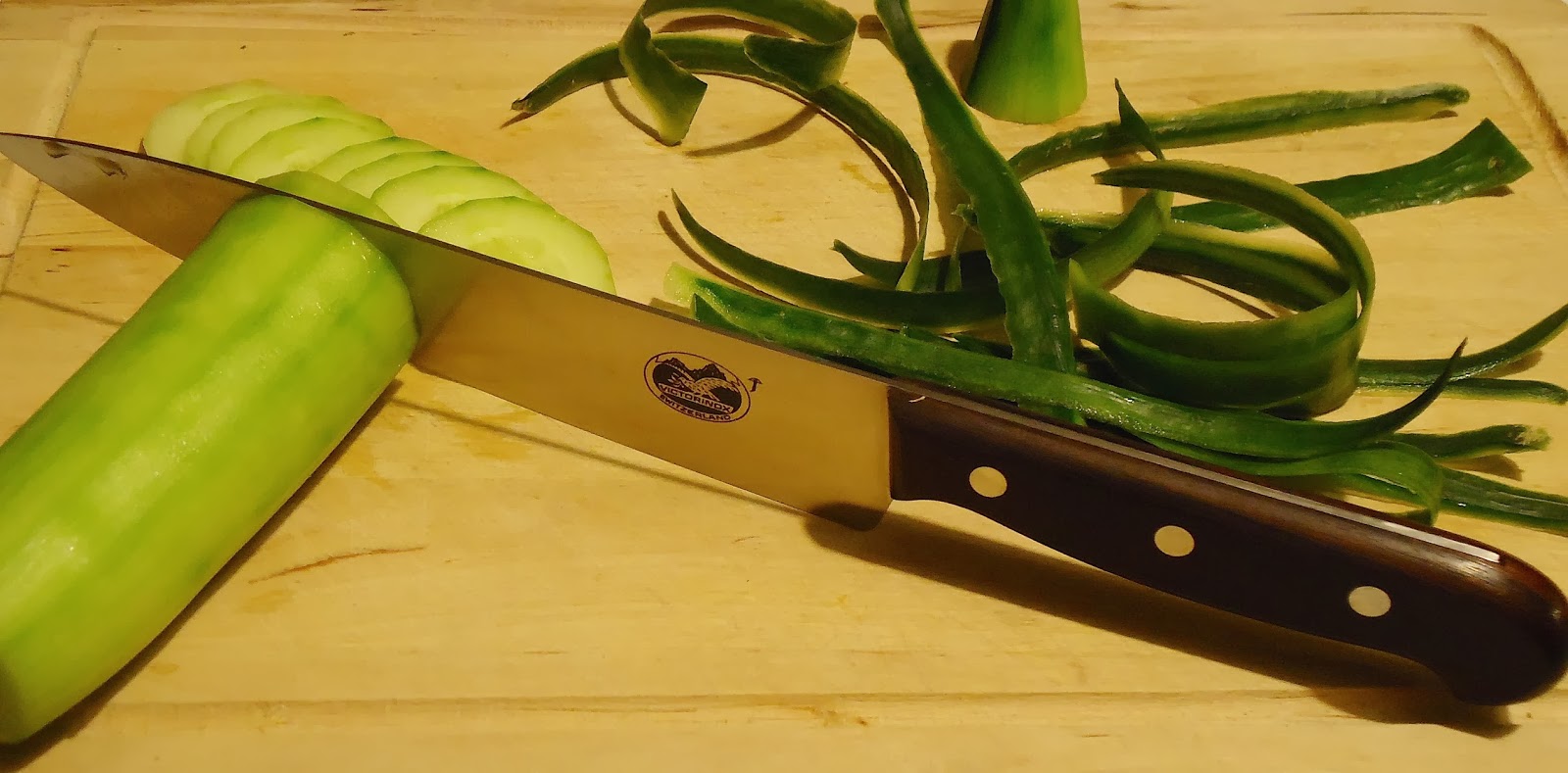
I'm not a masterchef, nor an ambitious cook, but I do master a love for good food... that's probably the reason why my weight is a bit too high. :) Ever since I started living together with my wife she gave me the choice to iron and wash the clothes or to cook every single day... Well, I never cooked before, but after a few weeks I noticed that I had some hidden talent... Now, "some" years later, I have a great array of kitchen knives, and after my last visit to Switzerland I started gathering the Victorinox kitchen knives, so I have some form of comparison. It's no secret that I like the Victorinox brand, but even with my eyes closed, I can pick out every knife made by them... These knives not only look good, but add a nice polished finish to make slicing through meat or vegetables easy as can be. Honestly, to me it doesn't change a lot if my kitchen knife has "made in China" or "made in Switzerland" on it, but if you cook with a certain pride and respect, you use the tools with a certain "value". I've seen knives from 20 Euro up to 100 Euro, and it's up to you what you prefer, or are willing to spend on a knife, but keep in mind that the low end knives (plastic handles) are more than sufficient for the amateur cook. I found a great deal on the knife and meat fork with Palissander handles (late 80's NOS), pictured below and use some knives with plastic handles for quite some time now. I've read some negative comments on the fact that the low end knives have no full tang blade, meaning that the steel stops less than half way the plastic handle. This is quality wise not so appealing, but if you treat the knife with some respect, you won't have any problems with it. Victorinox offers even a high end line for the more professional chefs, it just depends on what you want to do with it . Victorinox, you've gained my trust once again!


Wednesday, January 8, 2014
Victorinox scales strength test

After I heard someone claim that Cellidor scales aren't the strongest, I had to laugh. Cellidor was to my opinion strong, if not VERY strong! But that same guy verified his statement with a dishwasher experiment. He placed a Victorinox Spartan with Cellidor scales in the dishwasher and placed the picture online. I was a bit disappointed and did some tests myself. I did two main tests on 3 different Victorinox scales. First the scratch test. Everyone knows that wearing a Victorinox knife in your pocket results in scuffed and dented scales. I always wondered if other materials would have the same result so I took a punch tool and scratched a small cross in the three different materials. The first one on the left (A) is a Translucent scale and showed a very visible white scratch. The second one (B), the Cellidor scale did a bit better, but the scratch was still visible. The last one (C), a Nylon Economy scale surprised me. This was the cheapest and the strongest. I had some trouble to make the scratch the same depth as the other ones and afterwards it didn't look as ugly as the other two. This material is made to resist and it shows. Too bad it looks so damn ugly! By the way.... The scales I used are used donor-parts, so they were already scratched, but sanded and polished like new. The second test was how the different materials would react to hot water. This is to proof that these knives are safe to wash in very hot water (hotter than hot tap water, but NOT boiling!) or not! The Nylon one (C) is once again the winner, or better said, the only survivor. Let this be a good lesson... Stay away from HOT water (Not boiling!) Cellidor and Translucent scales have the tendency to bend if heated so be careful! ...


Tuesday, January 7, 2014
Victorinox evolution : Can opener & Cap lifter

I've made a few mods by now and after my first few knives I started noticing the small evolution that Victorinox made with every tool. Some are the more known ones, like the 90 degree lock on the cap lifter and the pat. marking on the can opener, but I'm here to talk about the small, but ingenious steps we didn't even know they existed. Sometimes it isn't necessary to inform the user about these changes because they're so small, but in use they make a huge difference. Let's start with the Can opener... Victorinox used the 1,5mm gap (A) between cutter and spine for ages and ever since the late nineties (according to my knives) they changed to the 3mm gap (B). Why? Well I can only guess, but the only advantage you would get with this change is a stronger spine and small screwdriver. The other one I wanted to talk about is the base of the Cap lifter. This changed after the 90 degree lock (A - B) was introduced. Victorinox used a plain square base (B) in the first generation Cap lifter, but after a while they removed a small strip on the left side. Again a guess, ... this must've been done to save in material costs and weight but this doesn't affect the overall strength. One other change is the nail notch. They moved this a bit closer to the screwdriver. I've seen many of these changes, even with the Swisstool. They changed the plier head-setup to strengthen the tool when used to loosen locked nuts... Again ingenious... This shows that, even if the overall design didn't change for over a century, the tools change constantly to evolve in an indestructible toolbox...

Subscribe to:
Posts (Atom)